Build a local mobility business with a plan for customers, vehicles, capital and operations.
Shared mobility. Local enterprise. A ten-year vision.
Shared mobility. Local enterprise. A ten-year vision.
October 2026 · Partnership vision
TAVX360 mission and venture strategy
01 / OUR BEGINNING02 / 35
Participate in the next decade of mobility
Own shares
Participate through share ownership, with returns tied to market prices and any dividends.
Build a business
Use the technology to serve customers. Participate through agreed ownership, operating roles and distributions after costs.
Build with TAVX360
Explore a ten-year partnership framework for company setup, capital planning, customer demand and operations.
Choose your role in the shift to EVs, autonomy, robotics and AI.
Proposed partnership framework. Business revenue is not owner profit. Stock and business ownership carry different risks; neither guarantees returns. Tesla affiliation is not implied.
TAVX360 participation strategy · Ownership comparison on slides 27–29.
02 / MISSION & VISION03 / 35
Bring your skills. Help move your community.
Our mission
Help people build local mobility businesses by connecting customers, vehicles and accountable operators.
Our vision
A connected network of local businesses helps communities move and gives people a practical role in the EV and autonomy transition.
Bring your experience, relationships or resources. Together, we define a role that fits.
Everyday access starts with people and places
Your contribution can become part of a local mobility business.
Crypto shows how new markets develop access products, custody and operating standards.
Physical autonomy
Driverless services are operating in selected markets. Expansion depends on more than vehicle capability.
Agents & robotics
Software can coordinate tasks while machines perform physical work.
The TAVX360 position
Develop the local customers, sites and accountable operators that connect those capabilities.
Connect the technology shift to a service people need.
TAVX360 strategic thesis. These sectors have different units, risks and business models. Their market figures cannot be added into one addressable market.
Sector evidence follows on slides 5–10.
04 / CRYPTO INVESTMENT SECTOR05 / 35
New markets need clear paths to participation
66%
Reported spot crypto ETF / ETP exposure
Among surveyed institutional decision-makers.
351
Institutional respondents
Coinbase / EY-Parthenon survey, January 2026.
The lesson for TAVX360 is disciplined access: clear agreements, transparent reporting and accountable operators help people evaluate participation.
Clear agreements and reporting help people evaluate a new opportunity.
Survey results describe this sample, not all institutions or a market valuation. Crypto is a comparison sector. TAVX360 does not propose a token or imply comparable investment returns.
Waymo’s published service figure, reviewed October 2026.
Our opportunity thesis
Build local demand and operating infrastructure that can serve available EV services now and authorized autonomy later.
Develop the customers and operating capacity future services will need.
Waymo’s figure is company-reported and applies to its service. It does not establish TAVX360 demand, network access, fleet economics or permission to operate driverless vehicles.
Survey-based measure reported by Stanford’s AI Index 2026.
Proposed agent-assisted work
Research a market, prepare a service plan, summarize operating records and flag exceptions for review.
TAVX360’s intelligence layer should make each next action clearer for the people responsible for service.
Give people clearer next actions between bookings.
AI adoption is broader than AI-agent deployment. The figure does not show that 88% of organizations operate autonomous agents. Proposed workflows require validation and defined access.
More than double the annual installations ten years earlier.
Potential local applications
Vehicle inspection support, site operations and last-mile handling are opportunities to evaluate as suitable products become available.
Evaluate practical uses where local service needs meet available technology.
Historical baseline from IFR World Robotics 2025. Industrial-robot installations are not a humanoid market estimate or a count of autonomous delivery vehicles. TAVX360 applications remain proposals.
WEF projects a net gain of 78 million jobs by 2030 across multiple economic and technological trends.
Our response: practical training and defined roles in customer service, fleet readiness, site coordination and local business operations.
Develop useful skills and defined responsibilities as the work evolves.
Global employer-survey projections, not observed outcomes or losses attributable to AI alone. New jobs do not automatically reach displaced workers. TAVX360 does not guarantee employment or replacement income.
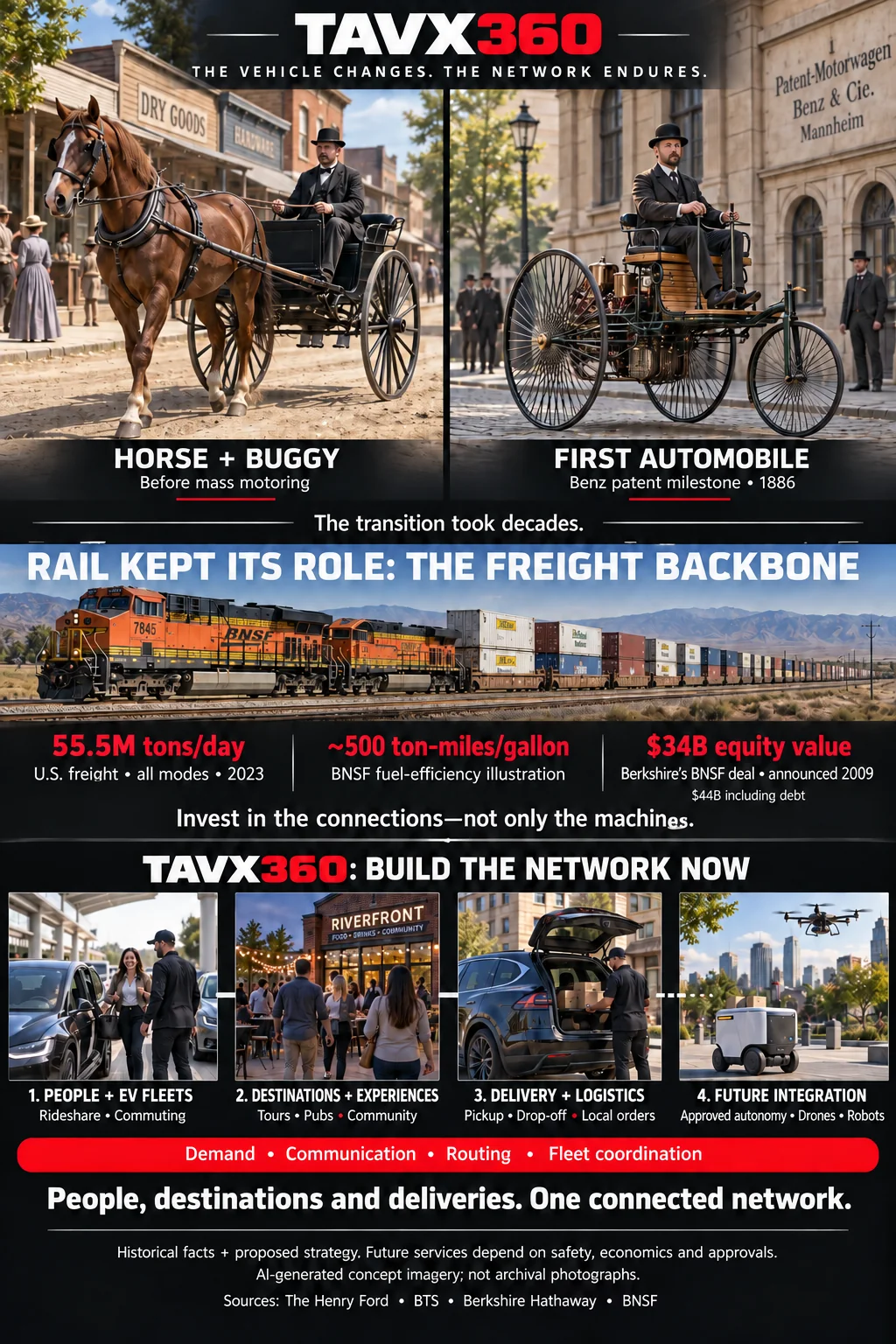
Build an operating position around customers, vehicles and sites.
Build an operating position around customers, vehicles and sites.
Historical analogy and proposed strategy. Technology transitions take different paths and do not establish a guaranteed investment window. The artwork is a conceptual illustration.
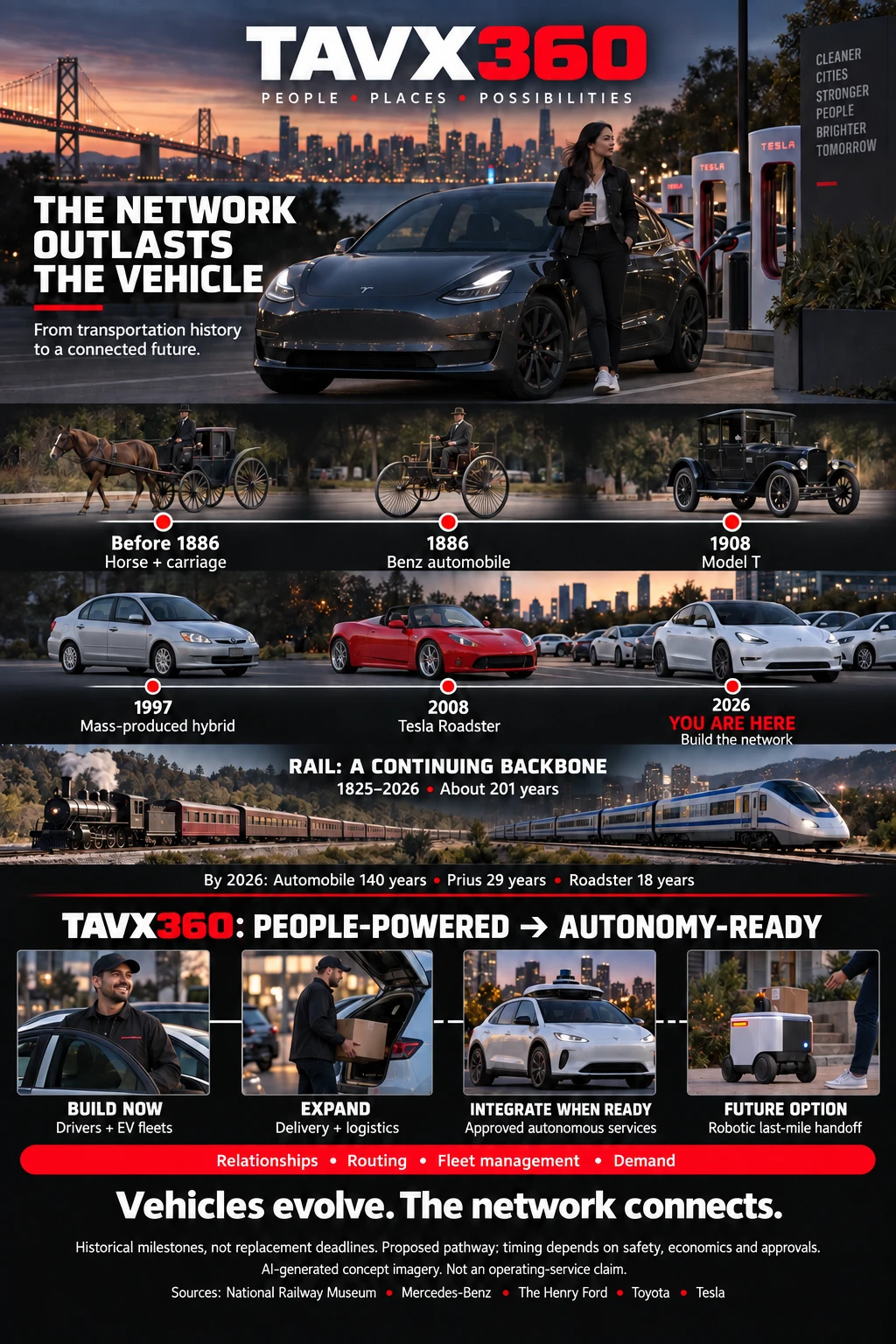
Electric vehicles and autonomy create different opportunities
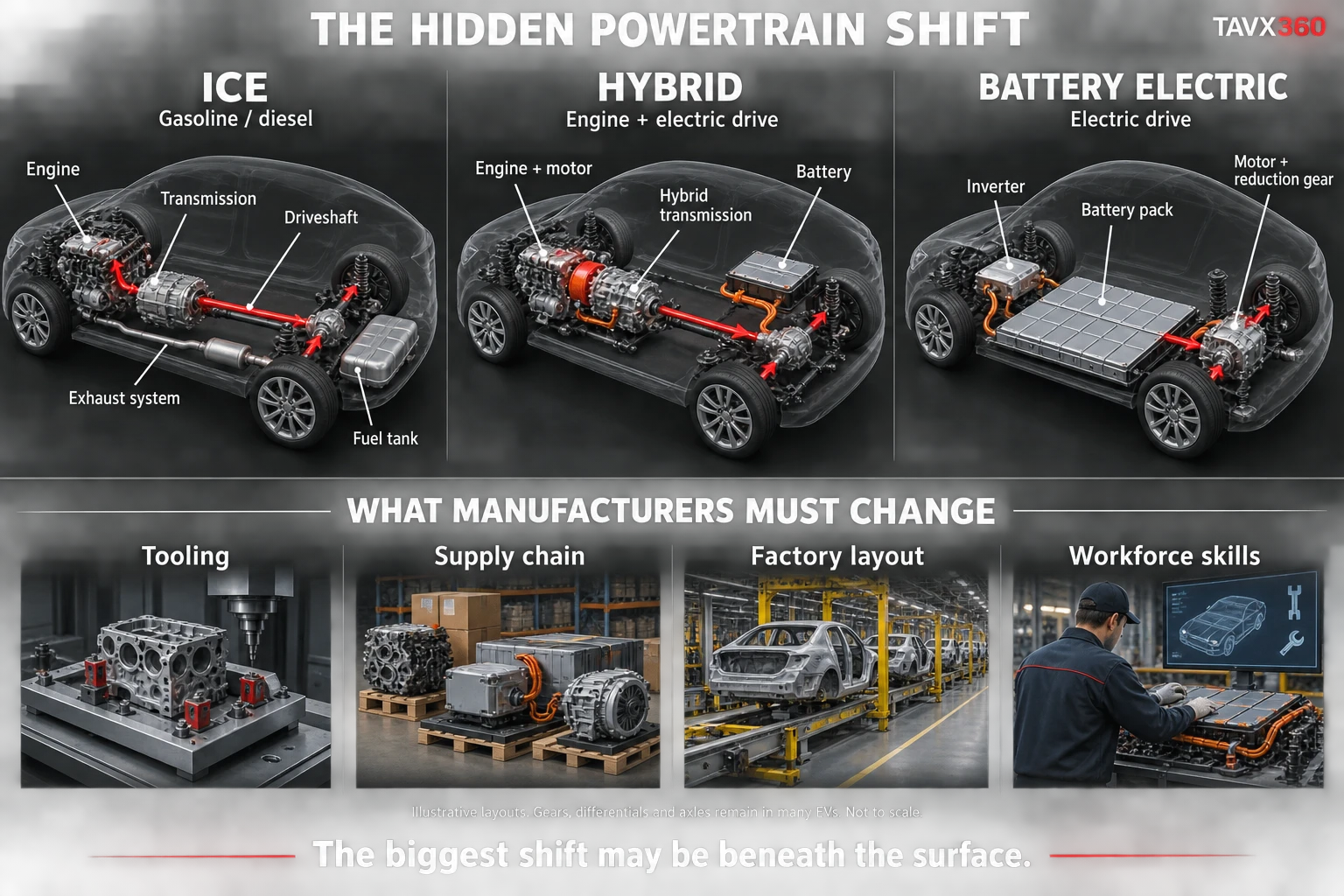
Powertrain
Electrification changes how a vehicle stores and uses energy.
Driving system
Automation changes which driving tasks a system can perform under defined conditions.
Operating business
Customers still need dependable access, service support and clear responsibility.
Choose a service based on what the vehicle can deliver today.
An EV is not automatically autonomous. Historical milestones and future concepts in the artwork are not universal adoption deadlines.
Vehicle-evolution briefing · Tesla FSD requirements
12 / COMMUNICATION EVOLUTION13 / 35
From faster information to coordinated services
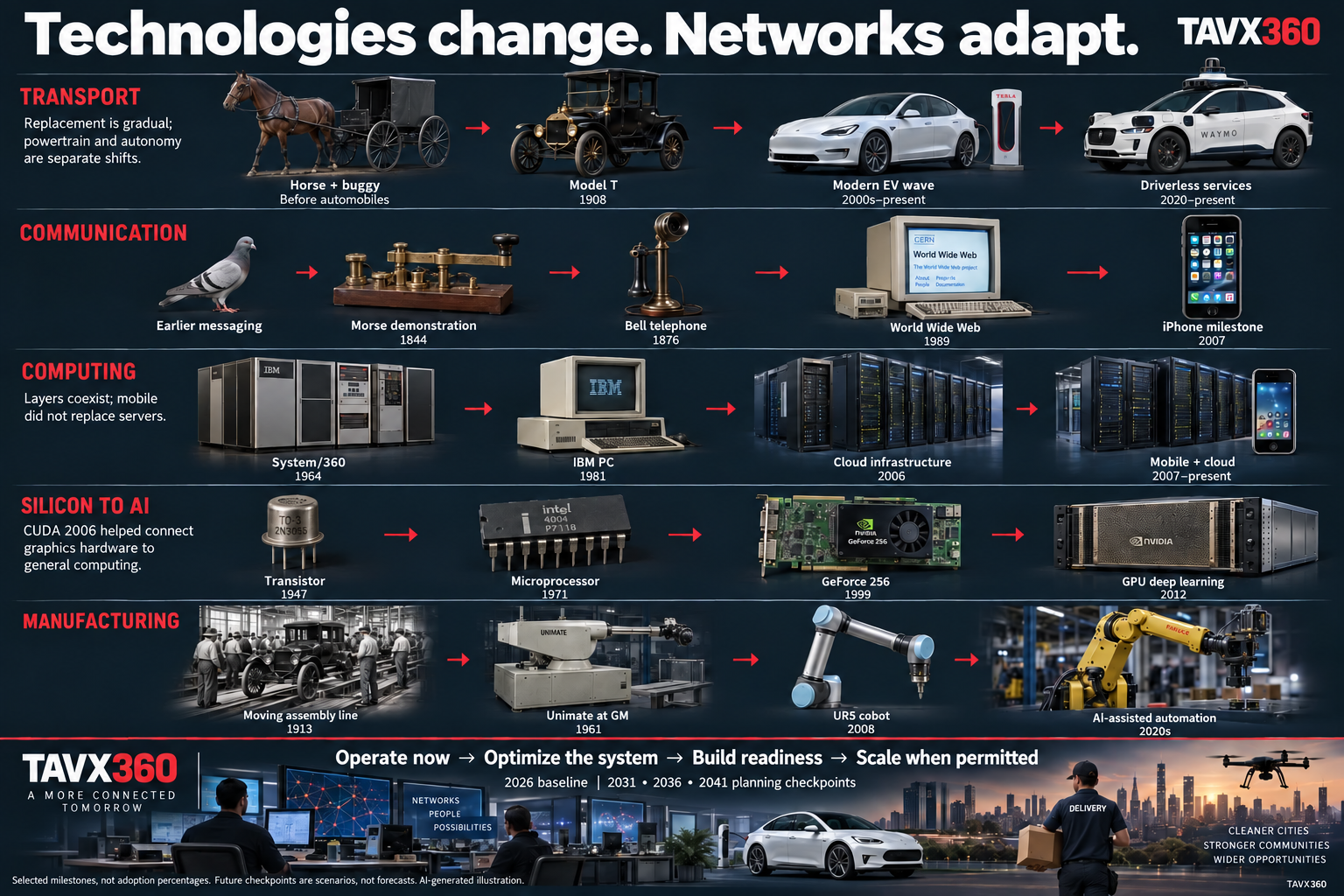
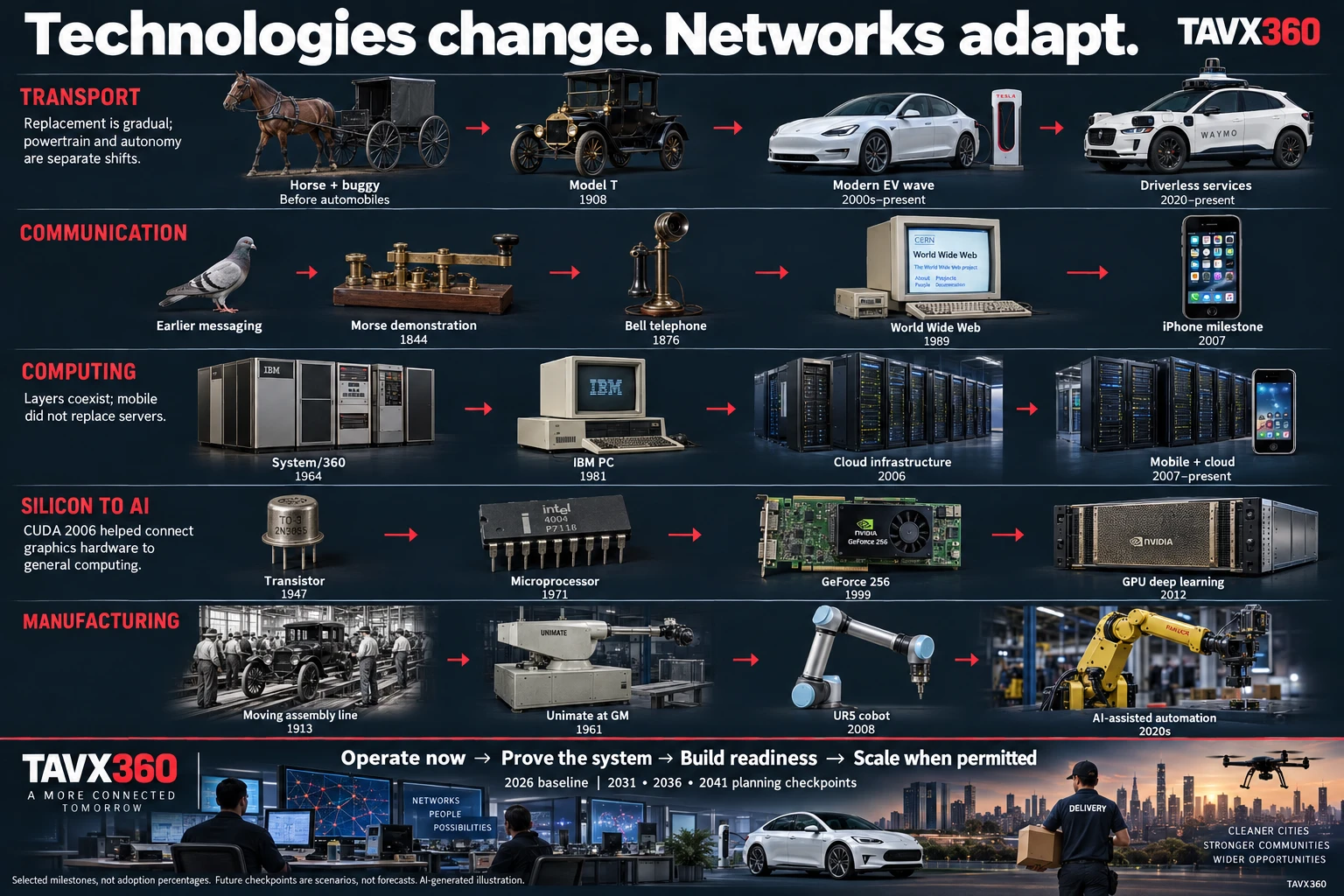
Telegraph
The 1844 Washington–Baltimore demonstration showed information could travel ahead of the journey.
Connected services
The web linked information and services. Today, booking requests, vehicle status and charging needs can inform the next action.
The TAVX360 lesson
Connect information to a responsible operator so customers receive a dependable service.
Information creates value when the network can act on it.
Selected milestones, not a claim that one technology replaced all previous systems. Historical analogy explains coordination rather than predicting business returns.
Library of Congress · CERN · TAVX360 coordination strategy
13 / COMPUTING EVOLUTION14 / 35
Connect information to the next useful action
IBM introduced System/360 in 1964 as a compatible computing family. Computing platforms have continued to evolve alongside networks and mobile access.
TAVX360’s proposed advantage comes from usable records: a service request connects to the vehicle, operator, destination and completed outcome.
Connect each request to a responsible person and a recorded outcome.
The business connection is TAVX360 analysis. Platform history does not demonstrate that TAVX360 has deployed every proposed integration.
A changing vehicle needs a changing support network
Ford’s Highland Park plant helped develop mass production of the Model T. Today’s EV transition reorganizes battery systems, motors, power electronics and charging needs.
The operating opportunity follows those physical changes: qualified maintenance, energy access, vehicle readiness and site partnerships.
Look for useful roles in charging, readiness, maintenance and sites.
Technology transitions create costs and disruption as well as opportunities. This is a strategy framework, not a forecast of industry-wide profitability.
Build useful services and local capacity around the EV transition.
Translate the global transition into a specific local service.
Electric-car figures include battery electric and plug-in hybrid cars. Global demand is context, not TAVX360’s addressable market or revenue.
IEA 2025 sales · IEA 2026 forecast
16 / CALIFORNIA & BAY AREA17 / 35
The future of shared mobility and self-guided tours
Shared mobility
Proposed starting focus: Oakland and the East Bay. Build recurring travel and errands around local operators and useful destinations.
Self-guided experiences
Explore visitor routes, individual trips and destination partnerships across San Francisco and the Bay Area.
A regional starting point
California passed 2.5 million cumulative new ZEV sales in 2025. Bay Area average one-way commute: 30 minutes in 2024.
Connect everyday journeys and visitor experiences through one local network.
Proposed service strategy. Local availability, routes, access and partnerships require validation. ZEV sales are cumulative and are not the current fleet; commute figures describe travel need.
CEC California ZEV adoption · MTC Vital Signs commute data · Founder direction
17 / FIRST CUSTOMERS18 / 35
Build customer demand before adding vehicles
Workplace partners
Approach employers and professional practices with recurring travel needs. Confirm schedules and demand before vehicle commitments.
Community routines
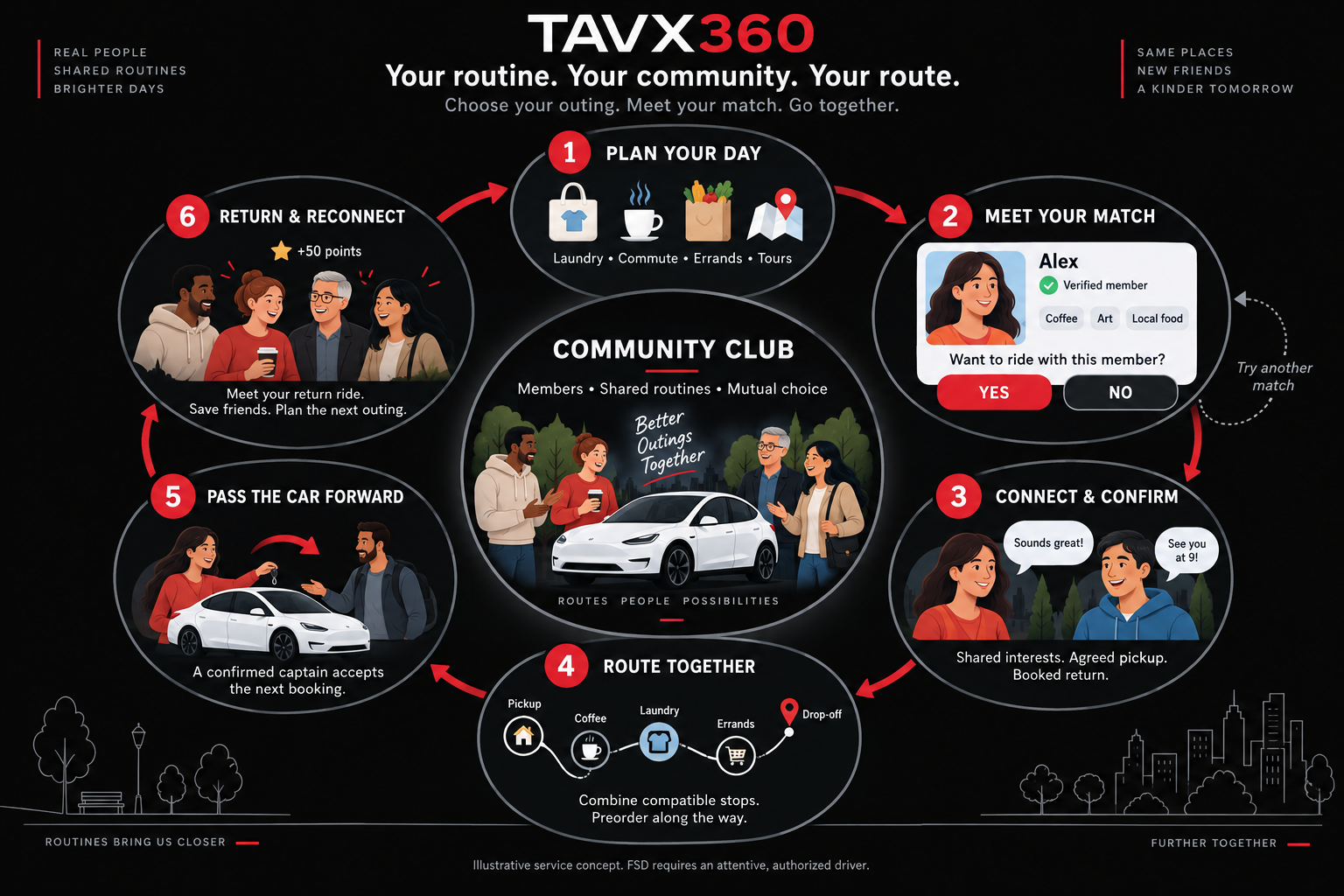
Recruit member groups around repeatable errands and mutually accepted shared trips.
Merchants & sites
Agree pickup windows, parking and service responsibilities with local businesses.
Acquisition discipline
Track qualified inquiries, completed bookings, repeat use and acquisition cost by channel.
Workplace relationships can help define recurring demand
Find repeat customers before committing to more capacity.
Proposed market-entry strategy. The deck does not claim signed workplace, merchant or community partnerships.
Illustration: four paid one-way member journeys per month at $7 each.
Active paying members
Monthly member journeys
Annual transport gross
100
400
$33,600
250
1,000
$84,000
500
2,000
$168,000
Gross receipts = active members × monthly paid journeys × price × 12. Capacity and actual demand must support each case.
Test demand and full costs before treating gross receipts as income.
Hypothetical steady-state arithmetic, not market size, forecast, profit or partner income. Each journey is one paying member’s one-way travel leg. Excludes membership and merchant revenue. Subtract full operating costs, taxes and reserves.
Illustrative $7 member fare from the published service example. Member counts and frequency are assumptions.
19 / THE CUSTOMER PROBLEM20 / 35
Dependable trips need a connected local network
People
Shift changes, errands and appointments create recurring transportation needs.
Businesses
Local logistics connects merchants with dependable arrivals, pickups and delivery windows.
Operators
Vehicles need customers, charging, maintenance and accountable handoffs.
TAVX360’s proposed network brings those dependencies into one operating plan.
Vehicle readiness connects energy, people and scheduling
Bring customers, vehicles, energy and responsible operators into one plan.
Broader platform participation across connected services.
Choose the service around your market, then evaluate the vehicles and full cost of delivery.
Match the business pathway to local demand and delivery costs.
Pathways are alternatives. Public gross-revenue targets are illustrative, not established earnings, profit or distributions. Photography illustrates possible uses and does not identify actual members or partners.
Stock: an interest in the issuer. Business: agreed ownership or vehicle rights in a local operating structure.
How value reaches you
Stock: price changes and any dividends. Business: distributable cash after costs and reserves, plus any realized equity value.
Your role
Stock: generally limited direct influence over operations. Business: agreed responsibilities or management oversight, with access to operating reports.
Trade-offs
Stock: market-price risk and exchange liquidity where available. Business: execution risk, concentrated exposure, capital commitments and limited liquidity.
Choose between share ownership and an active business role with clear trade-offs.
Both choices can lose capital. Business revenue is not owner profit. Business participation does not establish exposure to Tesla equity or affiliation with Tesla.
Use the same initial owner contribution and five- or ten-year horizon. Record every additional capital contribution.
Stock outcome
Compare ending sale proceeds plus dividends after fees and applicable taxes. Use explicit price-return assumptions rather than a promised result.
Business outcome
Compare owner distributions plus realizable equity after debt, exit costs and taxes. Account for owner labor, reinvestment and vehicle replacement.
Decision test
Review downside, base and upside cases. Test demand, utilization, pricing, financing and downtime before claiming the business outperforms a stock benchmark.
Evaluate distributions, equity, workload and risk on a consistent basis.
No comparative return is established. A financial comparison requires documented inputs and a consistent cash-flow method. Unsold business value is an estimate, not cash.
Coordinate entity selection, ownership records and governance with qualified legal and tax providers.
Strong capital structure
Define owner equity, debt, guarantees and partner rights. Match funding obligations to the operating plan.
Capital allocation
Plan vehicle acquisition, launch costs, insurance, charging, working capital and reserves. Set priorities before committing funds.
All partners aligned
Document who contributes capital, assets, demand or operating work. Agree responsibilities, reporting and decision rights.
Growth readiness
Review demand, unit economics, cash coverage, staffing and compliance before expanding.
Scale with discipline
Release capital against agreed milestones. Review performance with partners and adjust the growth plan.
Align the entity, the partners and the capital before scaling the network.
Proposed planning and coordination framework. Entity choice, financing and participation terms require qualified advice, approvals and written agreements. Capital availability and growth are not guaranteed.
TAVX360 company and capital planning · SBA startup and funding guidance
29 / THE INTELLIGENCE LAYER30 / 35
Use operating information to make better decisions
Knowledge
Organize source-led research and partner guidance with clear access boundaries.
Operations
Bring together booking status, vehicle readiness and service information.
Decisions
Use utilization, costs and customer outcomes to guide service and expansion choices.
Use customer outcomes and costs to guide the next operating decision.
This describes the platform direction. Integrations require defined data access, agreements and operating validation.
Governed intelligence and delivery platform
30 / TESLA & THE AUTONOMY HORIZON31 / 35
Build EV services today. Prepare for autonomy.
Current operating foundation
Human-operated EV services, approved drivers and documented service responsibilities.
Tesla FSD (Supervised) requires active driver supervision and does not make a vehicle autonomous.
Future opportunity
Evaluate self-driving services as technology, permissions and commercial access become available in each market.
Build the sites, customer relationships and operating discipline that a future service would still need.
An attentive driver remains responsible during supervised operation
Launch around available capability and evaluate autonomy as access develops.
TAVX360 is independent of Tesla, Inc. Tesla affiliation, network access and a deployed driverless TAVX360 service are not established.
Deploy to predefined locations for Rapid Rental, rapid reusability and reuse partnerships. Architect operating and government relationships around unmet needs. Develop partner referral funnels aimed at low customer acquisition cost (CAC). Validate the solution, then amplify demand as travel patterns shift.
YEAR 0210,000VEHICLE TARGET
Refine the models
Refine repeat demand across rental, Amazon Flex, airport pickup and delivery, and shared mobility. Find the intersections between services and refine the operating patterns that keep vehicles useful.
YEAR 0330,000VEHICLE TARGET
Engineer efficiency
Improve mapping, routing, agents and automation. Refine tours, self-guided and individual experiences, and microtransit. Prepare repeatable workflows and operating systems for scale.
YEAR 0470,000VEHICLE TARGET
Scale the network
Scale the refined business models. Deepen operating, government and demand partnerships. Grow capacity, locations and service coverage through relationships built in the earlier stages.
YEAR 05100,000VEHICLE TARGET
Activate the X factor
Prepare the network for the singularity: a significant shift in mobility and robotic capability. Position 100,000 vehicle units for the tectonic inversion of demand as the technology and market evolve.
Deploy → refine → improve efficiency → scale → activate the X factor.
Founder-set vehicle targets, not current fleet counts or a validated forecast. Execution depends on capital, demand, operating capacity, agreements and approvals. Named services identify proposed use cases; partnerships are not implied. The timing of the demand shift is uncertain.
Founder direction · Five-year network deployment strategy
32 / OUR TEN-YEAR VISION33 / 35
Ten years to develop lasting owner value
Years 1–5 · Operating foundation
Develop recurring demand, transparent records and a repeatable local business.
Years 6–7 · Network expansion
Replicate suitable services in additional territories through qualified local partners. Share standards and retain accountable local ownership.
Years 8–10 · Ownership options
Review reinvestment, debt reduction and permitted distributions. Evaluate expansion, succession or a potential sale against actual results.
Wealth-building aim: sustainable owner cash flow and business value developed over time.
The long-term vision connects independent businesses and local markets
Develop owner cash flow and business value through measured progress.
Ten-year planning relationship with annual plans, subject to the signed agreement. Business losses are possible. Income, valuation and an exit are not guaranteed.
Document current fleet, bookings and customer demand.
Validate vehicle-level costs and capital needs.
Confirm team roles and signed partner agreements.
Define the funding ask and proposed use of funds.
Document the ten-year relationship and annual review terms.
Use sourced research and validated operating inputs to decide what comes next.
Reviewed October 24, 2026. This participation deck states a proposed strategy and selected public research. It does not establish operating results or an investment offering.
Internal origin and network-thesis drafts inform the narrative. Public links above provide the principal website sources.