
MARKET SHIFT / 04 OF 08
From telegraph messages to a connected world
Opportunity / Page 02 — Communication is the coordination layer. Each shift changes what a network can do.
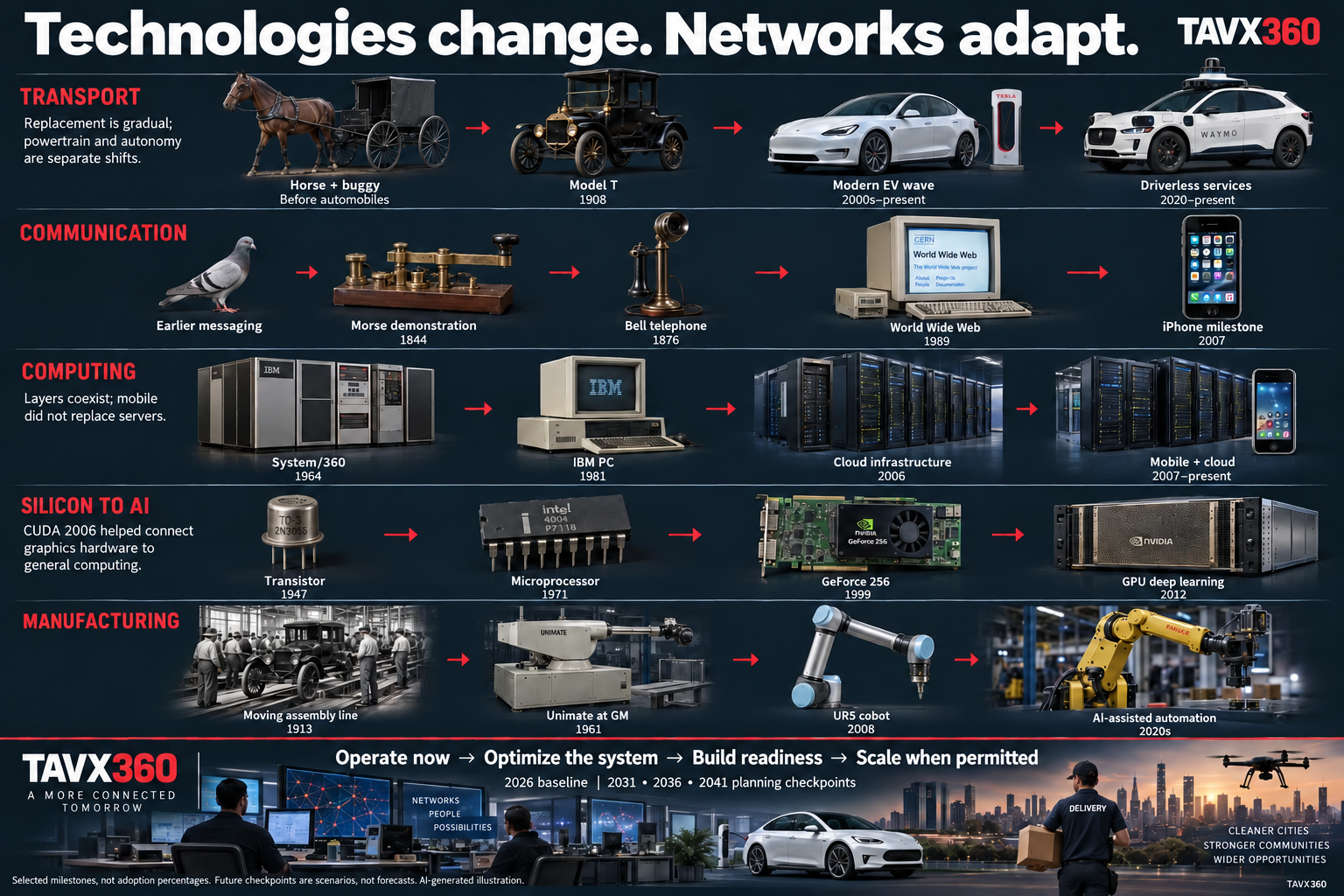
01 / THE TRANSITION
Shift 01 — Telegraph: information moves ahead of the journey
The telegraph changed the relationship between distance and information. A message no longer needed to travel with a messenger. Businesses could coordinate across locations before a person or shipment arrived. The Library of Congress documents this invention and its development.
For TAVX360, the lesson is advance knowledge. A customer request, an available vehicle, or a charging interruption becomes useful when the operator learns about it early enough to act. The opening is a service that reduces uncertainty, not merely another messaging tool.
02 / THE TRANSITION
Shift 02 — Telephone: coordination becomes a conversation
The telephone introduced direct voice interaction. The Library of Congress connects Bell’s work to attempts to improve the telegraph. A customer could explain a need, hear a response, and adjust a plan through conversation.
This remains an operating requirement. Missed pickups, accessibility needs, changing destinations, and service exceptions need a clear response channel. TAVX360 can combine digital booking with accountable customer support; software alone does not resolve every exception.
03 / THE TRANSITION
Shift 03 — The web: information becomes a connected service
CERN traces the web’s origin to 1989. Linking information created a foundation for people to discover and access services across organizations. The commercial implication is a customer journey that can span a fleet operator, a property host, and a destination.
Our opportunity is to make those connections practical: understandable service information, available inventory, bookings, partner terms, and a consistent operating record. A website should represent what can be delivered and explain the next action clearly.
04 / THE TRANSITION
Shift 04 — Mobile access: coordination reaches the moment of need
A mobile service brings the booking and communication layer into the trip itself. Customers can receive updates, find a pickup point, and contact the operator while moving. This changes the expected speed of response.
The TAVX360 design should prioritize clear pickup instructions, simple booking, visible charges, and rapid exception handling. Measure whether these tools reduce missed trips and improve repeat usage. Do not assume that app adoption establishes demand for a transport service.
05 / THE TRANSITION
Shift 05 — Connected operations: information becomes an operating layer
The next layer connects customer requests, vehicle availability, routes, charging, and destinations. Its value is a decision that improves the actual service: a feasible schedule, an avoided delay, or a better use of capacity.
Communication is a layer across the business. It connects transportation as an everyday utility, a price-sensitive commodity, and a leisure experience. Those services have different customer expectations, even when they use the same booking platform.
06 / THE TRANSITION
What changes next: transportation and the powertrain window
Read the transportation briefing next to see how everyday access, standardized trips, and premium experiences can coexist. Then read the powertrain report: manufacturing and energy infrastructure move more slowly than a software update, creating the urgency behind our execution plan.
The proposed window is 2026–2030, with a 2028 checkpoint. Our strategic thesis is that attractive early positions can become permanently unavailable once sites, contracts, and partner relationships are secured by others. That is a reason to act on a specific opportunity now, not a prediction that all future business disappears.
Primary sources
Sources support the factual context; TAVX360’s commercial interpretation is explained separately above.